Transnational project meetings
Experience of the consortium on site
Due to the Corona pandemic the 3rd Transnational Project Meeting was organized as an online event by the Italian partner CEIPES.
This time the Consortium had an opportunity to meet Ms. Marzia Musso, the councilor of the deaf national body for the district Palermo, who presented an overview about the access to different working fields for the deaf and hard of hearing people. Ms. Musso was supported by the sign language interpreter Taziana Giovanna di Vincenzo.
The first part of the ACPD TPM3, organized by project partner CEIPES, was a Meetiing with Ms. Marzia Musso, the councilor of the deaf national body for the district Palermo, working in office related to communication with deaf people of the region. National body of deaf persons is a body which tries to support the deaf people in different fields of life.
General experience in Sicily
The new law 6899 aims to protect the employability of people with different kinds of disability on every kind of work. The idea of this law is to obligate employers to hire one person with disability per every 15 employees (mandatory quote). MM sees the problem in treating by this law every kind of disability equally, which leads to the
situation that the deaf people stay unemployed, as the employers can “choose” the kind of disability which they find “acceptable” for their enterprise. MM is convinced
that the new law should be made for every kind of disability separately.
COVID-19
The pandemic situation made the employability of the deaf and hard of hearing people even harder. But the social isolation of the people with hearing impairment is getting
much more serious this time. Simply use of the mask leads to isolation for the deaf people because of the lack of the communication and impossibility to read lips. Meanwhile elderly people become depressed, because they have no easy access to the technical possibilities.
Italian Sign language
The Italian Sign Language is still not recognized as an official language in Italy, which has negative consequences for the deaf community in Italy. Important to mention: Deaf community is an official community and has to have the same tools and access to the communication to the society.
Lack of the supporting services
Since the mandatory support service for the deaf and hard of hearing people is not mentioned in any legislation, it leads to different accessibility problems. For example, it is a big deal for the deaf covid patients or deaf pregnant women to communicate with the medical staff at the hospital or just contacting a doctor, since there is no service support for them for the public bodies.
VET schools
There are some special schools for the deaf and hard of hearing students, but the decision is in the parents ́ hands, whether the child should visit a special or a mainstream school. The decision is made depending on the family ́s history and other deaf or hard of hearing cases in the family. It means, hearing parents tend to send their deaf children to the mainstream school, while the deaf or HOH parents rather let them visit a special school for the hearing impaired children. Employment service in the VET-schools provides teachers but not the support staff for the DHOH people. Even after participation on the training courses they can not be
employed, because they have no support. Regarding the lack of the support service: even in the University of Palermo there is very limited support service for the deaf and hard of hearing students available.
DHOH people in Sicilia in nursing and caretaking
In Sicilia there are only 1-2 persons, who work in the cleaning service in a hospital or in elderly care. Noone works in caretaking and nursing directly. Two other hard of hearing
persons are in training to become an assistant in health care, they use hearing aid and can study without the assistance.
Conclusion:
The society has to be 100% accessible for the deaf people.


Due to the Corona pandemic and changing travel regulations, the 2nd Transnational Project Meeting had to be spontaneously transformed into an online-event, organized and translated by the project partner Utenos Kolegija (Utena, Lithuania).
The TPM consisted of two online-meetings with external stakeholders and a project management conference for the partners to discuss the following steps of the project activities. During the online-meeting the partners learnt the Lithuanian Deaf Association, represented by its President, Mr. Kęstutis Vaišnora, who was supported by two sign language interpreters. In the second online-Meeting the invited director of Utena Sv. Klara hospice and lecturer at UC, dr. Žaneta Valiuliene, answered the questions of the consortium on the nursing and caretaking staff in the hospice and their professional training and professional development.
The first meeting was organised with the participation of the President of the Lithuanian Deaf Association, Kęstutis Vaišnora, supported by two sign language interpreters. During the meeting Mr. Vaišnora presented the Lithuanian Deaf Association and answered the consortium ́s questions.
The Lithuanian Deaf Association (LDA) was founded 1938 and the main goal is the providing of the sign language and strengthening its positions in the society. There are 6 000 deaf and 42 000 hard of hearing persons in Lithuania, the LDA has 3 000 members of deaf and hard of hearing persons at the age of 18 and older. There are also some other associations in Lithuania, such as the Association of parents of deaf children, the Deaf Youth Association etc.
Schooling for deaf and hard of hearing children:
There are 3 special schools for dear children in Lithuania, the teachers have to learn Lithuanian Sign language (LSL). The deaf and hard of hearing children can also go to schools for hearing children. As no special tools on “hearing schools” are provided to include the deaf and hard of hearing students, they can only try to learn in such a school according to their rest hearing abilities (sitting in the first row, lips reading etc). Also it is quite challenging for them to be integrated into the school community.
In 2019 the LDA hosted a meeting for the Ministry for Education and deaf students to discuss the meaning of the sign language for the deaf children, as well as for the colleges and universities.
The government provides a service for deaf and hard of hearing people, which allows to have a support of SL interpreters, but the big problem is the lack of the SL-interpreters in Lithuania (about 100 active SL-interpreters in the whole country; 1:60 ratio) as well as a lack of lecturers in high schools, who know SL. The lack of SL-interpreters results in shortage of specialists for SL translations. The further problem is that there is no any kind of specialization, so the same SL interpreter would translate at school, university, hospital or during a visit to the local authorities.
There are still many motivated students, who try to solve the communication problem. Mr. Vaišnora spoke about his own experience and told that he graduated from the university with BA and MA degrees, despite all the difficulties.
Education:
The students can learn the LSL at four universities in Lithuania. About 30 students a year choose an additional LSL-course. The LSL-study lasts three years, about 25 students start their study every year, about 15 students per year graduate.
International sign language (ISL):
There is a big difference between the Lithianian SL and International SL, that is why there is no possibility in Lithuania provided to learn the ILS. In Mr. Vaišnora ́s opinion, it is very difficult for an SL-interpreter to learn ILS as well as there is no real need for it in daily life. However, young people, who travel, communicate with deaf colleagues abroad and want to use modern social media, learn the basics of ILS by themselves, by just practicing on the internet or using the online courses. In general, learning of the ISL is a question of personal motivation.
Caretaking environment for deaf and hard of hearing people:
There are no special nursing houses for deaf elderly people, because the Convention on Disabilities does not allow to separate people because of their disabilities. Nevertheless the deaf community prefers to have such houses and wants to pursue this option in order to be able to communicate freely at such institutions.
By the end of the meeting Mr. Kęstutis Vaišnora expressed his hope to welcome the project partners face-to-face in Lithuania.

The second meeting was organised with the participation of the director of Utena Sv. Klara hospice and the lecturer on palliative are at Utena University of Applied Sciences, Dr. Žaneta Valiuliene.
The Utena Sv. Klara hospice takes care of 80 heavily sick, including terminal oncology, patients.
Challenge
The hospice employs two hard of hearing persons, but not in nursing/caretaking. Since both patients and other nurses need to be communicated with, Mrs. Valiuliene sees no current possibility in employment of the deaf nurses and caretakers. They could do certain manipulations, but cannot satisfy these compulsory communication ability requirements. When it comes to hard-of hearing patients in palliative care, the oral nurses can communicate with them in writing or sign language basics.
Work requirements
The requirements on caretakers and nurses at hospice are:
- for nurse specialists – nurse license and accredited nurse education
- for nursing assistant – completed nursing course, no license needed by now, but it will be mandatory from 2020.
The nurse training consists of 360 hours. Nursing assistants can be employed after taking part in the special courses of 60 hours (see above).
A nurse with a foreign diploma has to get its recognition in Lithuania, as well as to pass a state language exam, performing Lithuanian language at at least B2 level.
Advanced professional training
In order to refresh the nursing license, all nurses and nurse assistants have to take part in mandatory courses in first aid (60 hours in 5 years), which can be arranged in digital form. The staff also regularly discusses the demand for professional advanced training courses, which are then organized in different ways (mostly by center for nurses professional development,but also online-courses etc). Each such course has to be pre-approved by the Lithuanian Ministry of Health.
Since the pandemic many courses can run online. The theoretical part of 3 hours a week can be teached online, the practical needs the physical presence. There is a simulation center with different programs to train the students on a dummy. Most training courses are offered in Lithuanian language, because the nursing and caretaking staff is getting older and can communicate only in Lithuanian or Russian, but not in English or German.
The hospice has enough nursing and caretaking staff at the moment, since it is a training center for the universities and can scout the graduates. The other hospitals have a shortage of nursing staff.


The first transnational project meeting (kick-off) took place on the 29-30 January 2020 in Germany organized by the project coordinator INTAMT Academy.
During the first day, the partner organizations learnt each other in personal, introduced their organizations and presented the research results including the statistics on employment rate of people with disabilities and the VET possibilities for deaf and hard of hearing on nursing and caretaking in Lithuania, Romania, Bulgaria, Germany and Italy. Furthermore, the partners discussed the issues and aims of the project as well as the barriers and the practical steps of implementation.


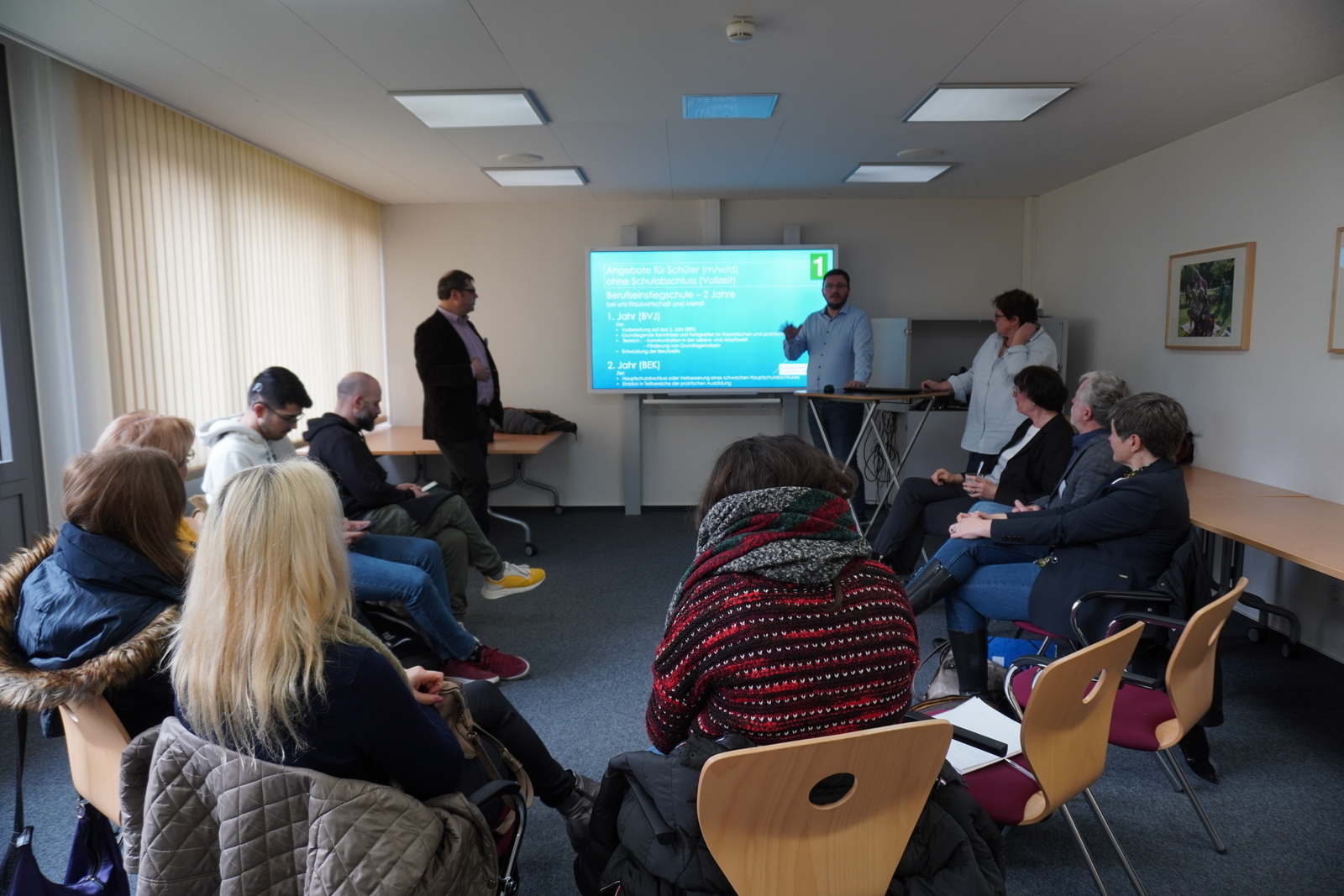
On the second day, INTAMT Academy organized site visit to the state educational center for hearing impaired in Osnabruck. The LBZH – state education center offers educational programs for “-helper” or “-assistance” in care (duration 2 years), where 7 hearing impaired students a year are trained on nursing assistance.
Firstly the presentation of the Center was made by the director, Christoph Plickert. The vocational college is a part of the biggest educational center for deaf and hard of hearing people in the whole federal state Lower Saxony. The Centre includes kindergarten, elementary school and two secondary school levels (300 pupils), consulting center and a VET-Centre (100 students).
Thereafter a tour of the facilities was made lead by Elisabeth Boymann, who is the head of the VET-School for the hearing impaired. During the visit the consortium learned about the scope of educational and training programmes, teaching methods and technical support for young people with hearing disabilities, the requirements to access the vocational educational training, and the cooperation of the VET-Centre with different health- and caretaking institutions as educational partner and future employees for the trainees.
She presented a classroom in detail and explained the important facilities for teaching hearing impaired students, such as floor covering, shadow free light system, sound insulation, special sound device, which was connected to the teacher´s microphone etc.
A separate session took place in the further course of the meeting hosted by the colleagues from the caretaking training department.